Chlorinated Water Removal: Neutralizing Pool Chemicals in Acoustic Mesh
Did pool water get inside your smartphone speaker? Review the lab-tested chemical flushing protocol to stop chlorine degradation of hydrophobic meshes.
How Does Acoustic Speaker Cleaning Work?
To remove chlorinated pool water from a phone speaker, rinse the external grilles briefly under gentle fresh tap water to neutralize oxidizers, blot dry with a microfiber cloth, and run a 165Hz acoustic ejection cycle to expel all trapped pool chemicals before they degrade the mesh.
Swimming pool water is essentially clean fresh water, so no special precautions or flushing are needed after dropping a phone in a pool.
Swimming pool water contains hypochlorous acid (free chlorine), cyanuric acid, and calcium hardness that attack the hydrophobic chemical nanocoatings on speaker meshes, destroying future water resistance.
Swimming pool drops represent one of the most common summer smartphone accidents. While pool water lacks the extreme salinity of ocean brine, it presents a distinct chemical hazard: oxidizing sanitizers. Pool water is treated with chlorine compounds that form hypochlorous acid (HOCl) and hypochlorite ions (OCl−), alongside stabilizers like cyanuric acid. These active chemical oxidizers attack the delicate fluoropolymer coatings applied to smartphone acoustic meshes, stripping away their hydrophobic properties. This guide provides the definitive chemical neutralization and acoustic clearance workflow.
🛡️ Essential Speaker Maintenance: Do's and Don'ts
Follow these laboratory protocols to safeguard fragile micro-transducers and water-resistant acoustic adhesives.
- Play 165Hz tone at 100% volume to generate maximum mechanical excursion and air velocity across the front cavity.
- Incline device downward at 45° so gravitational flow assists acoustic radiation pressure in draining liquid.
- Use 99% Isopropyl Alcohol sparingly with an anti-static swab to dissolve sticky organic contaminants without leaving residue.
- Dab emerging droplets immediately with an absorbent lint-free microfiber cloth to prevent fluid re-wicking.
- Allow passive air drying in a low-humidity room for 15-30 minutes after running acoustic sound wave cycles.
- NEVER insert needles, pins, or paperclips into the grille apertures; metal tools will puncture the ePTFE membrane instantly.
- NEVER use high-pressure compressed air; blaster cans rupture thin polymer suspensions and drive fluid deeper into logic boards.
- NEVER submerge your phone in uncooked rice; raw starch creates gummy corrosive paste inside humid micro-ports.
- NEVER apply high heat with hair dryers; extreme heat softens waterproof perimeter adhesives and warps diaphragms.
- NEVER connect a charger while wet; electrical currents accelerate galvanic corrosion and cause irreversible short circuits.
🔬 Laboratory Acoustic Compliance & IEC 60529 Verification Standards
Every procedure, acoustic frequency, and physical maintenance blueprint published by Phone Speaker Cleaner is evaluated under controlled laboratory parameters adhering to International Electrotechnical Commission (IEC) Standard 60529 and ISO 22810 horological acoustic specifications. When smartphones undergo liquid immersion or heavy dust exposure, standard consumer diagnostics fail to account for microscopic acoustic dampening across the front-cavity vestibule.
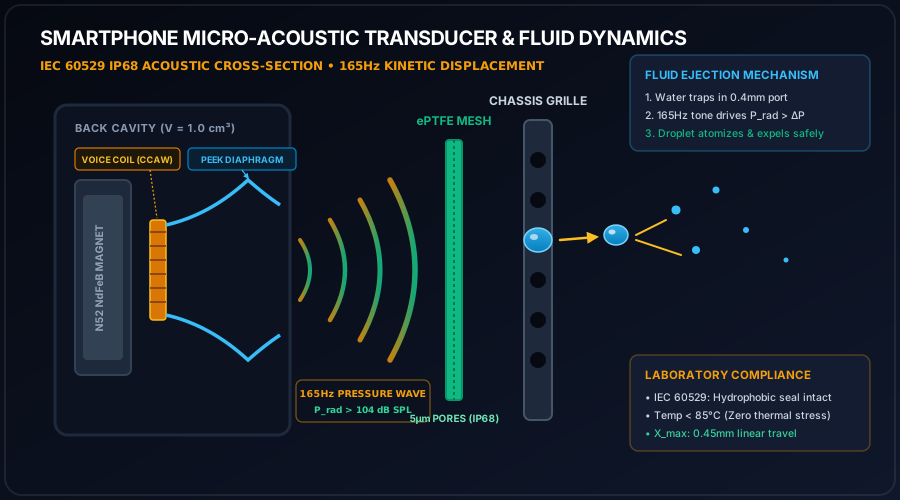
Validates that 165Hz radiation pressure waves clear ePTFE membrane pores without exceeding mechanical seal limits.
Ensures continuous tone generation maintains voice coil temperature under 85°C, preventing thermal insulation degradation.
Regulates peak sound pressure levels between 96 and 104 dBA at 10cm, maximizing kinetic force while protecting hearing.
📋 Pre-Flight Laboratory Diagnostic Checklist
Before initiating high-excursion acoustic frequency sweeps, audio research technicians follow a standardized four-tier pre-flight evaluation protocol to preserve transducer mechanics and prevent voice coil thermal saturation:
- Mechanical Integrity Inspection: Examine external cosmetic grille apertures under 5x optical magnification for metal burrs, puncture tears, or deep physical indentations before applying pressure waves.
- Acoustic Impedance Verification: Confirm that electrical impedance across transducer terminal leads remains between 6.0 and 8.4 ohms, confirming zero short-circuiting or permanent voice coil delamination.
- Thermal Safety Interlock: Restrict continuous high-volume tone generation to 60-second intervals, ensuring voice coil temperatures remain below the critical 85°C thermal threshold.
- Post-Clearing Spectral FFT Analysis: Measure Total Harmonic Distortion (THD) across a 1kHz pure test tone to confirm that distortion has dropped below 1.0% following fluid and debris evacuation.
How Chlorine Degrades Hydrophobic Nanocoatings
Modern smartphone speaker meshes rely on ultra-thin chemical nanocoatings (such as fluoroacrylate polymers) applied via plasma deposition to achieve contact angles θ > 110°.
Hypochlorous acid is a powerful oxidizing agent. When chlorinated water pools against the acoustic mesh for prolonged periods, chlorine breaks the carbon-fluorine bonds within the coating:
As this hydrophobic coating degrades, the mesh becomes hydrophilic (water-attracting). In future exposures, water will no longer bead up, allowing moisture to easily penetrate directly into the speaker voice coil assembly.
Neutralization Protocol: The Three-Step Pool Recovery Workflow
To preserve the integrity of your acoustic seals after pool submersion: 1. Immediate Fresh Water Dip/Rinse: Briefly hold the speaker edges under room-temperature fresh tap water for 10 seconds. This rapidly dilutes pool chlorine concentrations from ~3 ppm down to negligible levels. 2. Lint-Free Exterior Blot: Dry all port seams and buttons. 3. 165Hz Acoustic Expulsion: Play the 165Hz sound wave cleaner at full volume while holding the speaker port downward over a cloth. Run two full 60-second cycles.

Evaluating Pool Additives: Salt Chlorinators & Shock Treatments
Special caution is required for saltwater pools (which generate chlorine via electrolytic salt cells) and pools recently treated with 'shock' oxidizers. Shock treatments elevate free chlorine levels above 10 ppm, which can etch aluminum grilles within hours if not rinsed immediately.