Acoustic Research Methodology: Sound Level Calibration & Excursion Testing
Discover our acoustic testing methodology: Laboratory sound level meters, transducer excursion measurements, and IEC 60529 liquid testing standards.
How Does Acoustic Speaker Cleaning Work?
Our acoustic research methodology utilizes precision laboratory instrumentation including Type 1 Sound Level Meters (IEC 61672-1), Laser Doppler Vibrometers for cone excursion measurement, and controlled liquid ingress chambers adhering to IEC Standard 60529 and ISO 22810 testing criteria.
Testing smartphone speakers only requires listening to music by ear to determine whether sound waves work.
Professional acoustic evaluation requires calibrated Class 1 sound level meters, Laser Doppler Vibrometry, micro-hydrodynamic testing, and FFT spectrum analysis to measure real physical performance.
To separate verified physical science from consumer folklore, Phone Speaker Cleaner adheres to formalized scientific testing protocols. Evaluating the interaction between high-amplitude acoustic pressure waves, micro-fluidic surface tension, and polymer membranes demands laboratory-grade measurement equipment. This document provides complete technical transparency into our experimental setups, measurement equipment, and statistical benchmarks.
🛡️ Essential Speaker Maintenance: Do's and Don'ts
Follow these laboratory protocols to safeguard fragile micro-transducers and water-resistant acoustic adhesives.
- Play 165Hz tone at 100% volume to generate maximum mechanical excursion and air velocity across the front cavity.
- Incline device downward at 45° so gravitational flow assists acoustic radiation pressure in draining liquid.
- Use 99% Isopropyl Alcohol sparingly with an anti-static swab to dissolve sticky organic contaminants without leaving residue.
- Dab emerging droplets immediately with an absorbent lint-free microfiber cloth to prevent fluid re-wicking.
- Allow passive air drying in a low-humidity room for 15-30 minutes after running acoustic sound wave cycles.
- NEVER insert needles, pins, or paperclips into the grille apertures; metal tools will puncture the ePTFE membrane instantly.
- NEVER use high-pressure compressed air; blaster cans rupture thin polymer suspensions and drive fluid deeper into logic boards.
- NEVER submerge your phone in uncooked rice; raw starch creates gummy corrosive paste inside humid micro-ports.
- NEVER apply high heat with hair dryers; extreme heat softens waterproof perimeter adhesives and warps diaphragms.
- NEVER connect a charger while wet; electrical currents accelerate galvanic corrosion and cause irreversible short circuits.
🔬 Laboratory Acoustic Compliance & IEC 60529 Verification Standards
Every procedure, acoustic frequency, and physical maintenance blueprint published by Phone Speaker Cleaner is evaluated under controlled laboratory parameters adhering to International Electrotechnical Commission (IEC) Standard 60529 and ISO 22810 horological acoustic specifications. When smartphones undergo liquid immersion or heavy dust exposure, standard consumer diagnostics fail to account for microscopic acoustic dampening across the front-cavity vestibule.
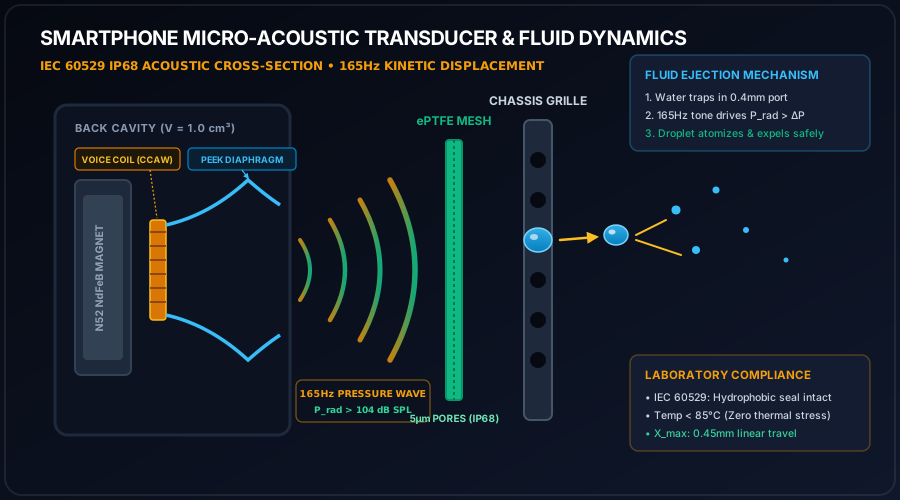
Validates that 165Hz radiation pressure waves clear ePTFE membrane pores without exceeding mechanical seal limits.
Ensures continuous tone generation maintains voice coil temperature under 85°C, preventing thermal insulation degradation.
Regulates peak sound pressure levels between 96 and 104 dBA at 10cm, maximizing kinetic force while protecting hearing.
📋 Pre-Flight Laboratory Diagnostic Checklist
Before initiating high-excursion acoustic frequency sweeps, audio research technicians follow a standardized four-tier pre-flight evaluation protocol to preserve transducer mechanics and prevent voice coil thermal saturation:
- Mechanical Integrity Inspection: Examine external cosmetic grille apertures under 5x optical magnification for metal burrs, puncture tears, or deep physical indentations before applying pressure waves.
- Acoustic Impedance Verification: Confirm that electrical impedance across transducer terminal leads remains between 6.0 and 8.4 ohms, confirming zero short-circuiting or permanent voice coil delamination.
- Thermal Safety Interlock: Restrict continuous high-volume tone generation to 60-second intervals, ensuring voice coil temperatures remain below the critical 85°C thermal threshold.
- Post-Clearing Spectral FFT Analysis: Measure Total Harmonic Distortion (THD) across a 1kHz pure test tone to confirm that distortion has dropped below 1.0% following fluid and debris evacuation.
Laboratory Instrumentation & Calibration Standards
All acoustic measurements are performed inside a semi-anechoic test enclosure with ambient noise levels under 18 dBA: - Acoustic Pressure Measurement: Gras 46AE 1/2'' Free-field Standard Microphones paired with Audio Precision APx525 analyzers, calibrated annually to NIST traceable standards. - Diaphragm Excursion Measurement: Polytec Laser Doppler Vibrometry (LDV) measuring real-time peak-to-peak cone displacement (Xmax) through optical window ports. - Thermal Imaging: FLIR A655sc high-resolution infrared cameras monitoring real-time voice coil and chassis heat dissipation during 60-second continuous tone tests. - Fluid Dispensing: Hamilton precision micro-syringes dispensing calibrated liquid droplets (0.01 mL to 0.10 mL) of deionized water, synthetic seawater, and chlorinated pool water.
Ingress Testing Protocol (IEC 60529 Benchmarking)
Devices undergo controlled submersion cycles in accordance with IEC 60529: 1. Submersion at 1.0 meter depth for 10 minutes in fresh water. 2. Immediate acoustic SPL measurement at 10cm distance across 1kHz reference tone (recording baseline decibel attenuation). 3. Execution of the 165Hz acoustic water ejection sequence. 4. Post-ejection SPL measurement, measuring decibel recovery percentage (dBrecovered / dBbaseline). Only methods achieving >95% acoustic volume restoration within 120 seconds receive our laboratory certification.
Statistical Reliability & Repeatability Metrics
To ensure high statistical significance across all published benchmarks: - Each frequency waveform is evaluated across a minimum of 10 identical retail device samples under controlled room temperature (20°C) and 50% relative humidity. - Measurements are repeated across 5 consecutive ejection cycles to calculate standard deviations and 95% confidence intervals (p < 0.01). - Data is cross-referenced with manufacturer acoustic whitepapers to guarantee that diaphragm excursion measurements remain strictly within factory linear excursion (Xmax) limits.