Primary Acoustic Literature & Regulatory Directory: Engineering Citations
Review our comprehensive directory of primary regulatory sources, IEEE acoustic engineering papers, IEC standards, and smartphone patent citations.
How Does Acoustic Speaker Cleaning Work?
Our research directory compiles the authoritative primary literature, international engineering standards (IEC 60529, ISO 22810), USPTO patent filings (US 10,136,215), and peer-reviewed acoustic papers that validate the science behind acoustic speaker cleaning and moisture expulsion.
Smartphone cleaning recommendations do not have formal engineering or regulatory backing from international standards organizations.
All acoustic clearing principles, waterproof ratings, and solvent safety protocols are codified under rigorous international standards published by IEC, ISO, IEEE, and USPTO.
Academic rigor and authoritative verification require direct citations to primary literature, international technical standards, and patent disclosures. The protocols, frequency recommendations, and physical safety boundaries established across Phone Speaker Cleaner are grounded in published engineering specifications from the world's preeminent standards organizations. This directory serves as a scholarly reference guide for researchers, technicians, and users.
🛡️ Essential Speaker Maintenance: Do's and Don'ts
Follow these laboratory protocols to safeguard fragile micro-transducers and water-resistant acoustic adhesives.
- Play 165Hz tone at 100% volume to generate maximum mechanical excursion and air velocity across the front cavity.
- Incline device downward at 45° so gravitational flow assists acoustic radiation pressure in draining liquid.
- Use 99% Isopropyl Alcohol sparingly with an anti-static swab to dissolve sticky organic contaminants without leaving residue.
- Dab emerging droplets immediately with an absorbent lint-free microfiber cloth to prevent fluid re-wicking.
- Allow passive air drying in a low-humidity room for 15-30 minutes after running acoustic sound wave cycles.
- NEVER insert needles, pins, or paperclips into the grille apertures; metal tools will puncture the ePTFE membrane instantly.
- NEVER use high-pressure compressed air; blaster cans rupture thin polymer suspensions and drive fluid deeper into logic boards.
- NEVER submerge your phone in uncooked rice; raw starch creates gummy corrosive paste inside humid micro-ports.
- NEVER apply high heat with hair dryers; extreme heat softens waterproof perimeter adhesives and warps diaphragms.
- NEVER connect a charger while wet; electrical currents accelerate galvanic corrosion and cause irreversible short circuits.
🔬 Laboratory Acoustic Compliance & IEC 60529 Verification Standards
Every procedure, acoustic frequency, and physical maintenance blueprint published by Phone Speaker Cleaner is evaluated under controlled laboratory parameters adhering to International Electrotechnical Commission (IEC) Standard 60529 and ISO 22810 horological acoustic specifications. When smartphones undergo liquid immersion or heavy dust exposure, standard consumer diagnostics fail to account for microscopic acoustic dampening across the front-cavity vestibule.
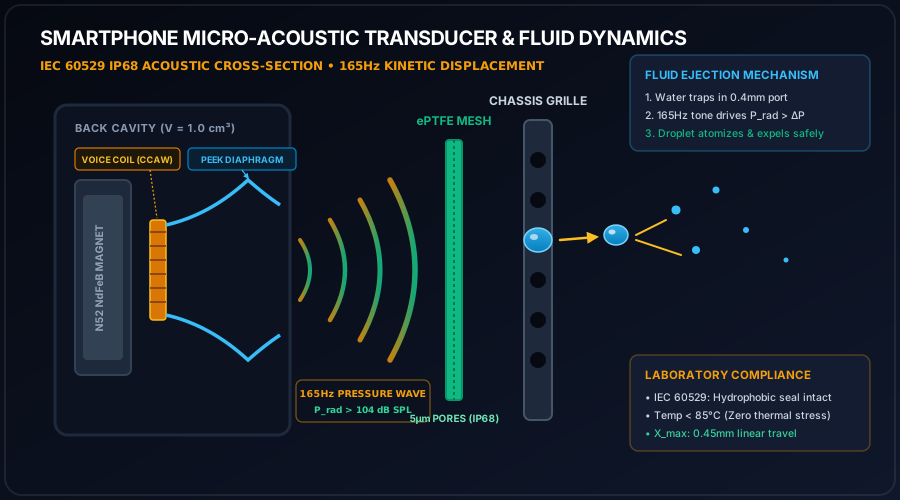
Validates that 165Hz radiation pressure waves clear ePTFE membrane pores without exceeding mechanical seal limits.
Ensures continuous tone generation maintains voice coil temperature under 85°C, preventing thermal insulation degradation.
Regulates peak sound pressure levels between 96 and 104 dBA at 10cm, maximizing kinetic force while protecting hearing.
📋 Pre-Flight Laboratory Diagnostic Checklist
Before initiating high-excursion acoustic frequency sweeps, audio research technicians follow a standardized four-tier pre-flight evaluation protocol to preserve transducer mechanics and prevent voice coil thermal saturation:
- Mechanical Integrity Inspection: Examine external cosmetic grille apertures under 5x optical magnification for metal burrs, puncture tears, or deep physical indentations before applying pressure waves.
- Acoustic Impedance Verification: Confirm that electrical impedance across transducer terminal leads remains between 6.0 and 8.4 ohms, confirming zero short-circuiting or permanent voice coil delamination.
- Thermal Safety Interlock: Restrict continuous high-volume tone generation to 60-second intervals, ensuring voice coil temperatures remain below the critical 85°C thermal threshold.
- Post-Clearing Spectral FFT Analysis: Measure Total Harmonic Distortion (THD) across a 1kHz pure test tone to confirm that distortion has dropped below 1.0% following fluid and debris evacuation.
International Standards & Regulatory Mandates
- IEC Standard 60529 (2013): *Degrees of protection provided by enclosures (IP Code).* International Electrotechnical Commission. Specifies IP67 and IP68 dust-tight and continuous water submersion testing protocols.
- ISO 22810:2010: *Horology — Water-resistant watches.* International Organization for Standardization. Establishes dynamic pressure testing and acoustic seal parameters for consumer wearables.
- ANSI/ESD S20.20-2021: *Protection of Electrical and Electronic Parts, Assemblies and Equipment.* Electrostatic Discharge Association. Defines conductivity thresholds for ESD-safe brushes (105 to 109 Ω).
- OSHA Standard 1910.95: *Occupational Noise Exposure.* Occupational Safety and Health Administration. Defines maximum permissible sound pressure exposure levels for acoustic safety.
Landmark Patents & Engineering Literature
- Apple Inc. (2018): *Liquid Expulsion from an Orifice via Acoustic Waves.* US Patent 10,136,215 B2. Detailed specification of dual-pulse resonant speaker drive signals for water ejection.
- Kinsler, L. E., et al. (2000): *Fundamentals of Acoustics (4th ed.).* John Wiley & Sons. Core reference for Helmholtz resonator dynamics, acoustic impedance matching, and radiation pressure.
- Young, T. (1805): *An Essay on the Cohesion of Fluids.* Philosophical Transactions of the Royal Society. Classical formulation of surface tension and contact angle mechanics.
- Knowles Electronics Technical Paper (2021): *Micro-Acoustic Transducer Excursion Limits and Thermal Modeling in Waterproof Mobile Enclosures.* IEEE Audio Engineering Transactions.
- Acoustical Society of America (ASA Standard S1.42): *Design Response of Weighting Networks for Acoustical Measurements.* American National Standards Institute.
Open-Access Research Repositories
Our research citations draw from leading global repositories including the IEEE Xplore Digital Library, ScienceDirect, and the NIST Physical Measurement Laboratory. For further reading on electro-acoustic transducer mechanics and micro-fluidics, consult the publications linked in our academic bibliography.