Apple Watch Water Lock Acoustic Method: Patent Analysis & Smartphone Porting
How does the Apple Watch Water Lock actually eject water? Read the engineering patent breakdown and apply the proven acoustic pulse to smartphone speakers.
How Does Acoustic Speaker Cleaning Work?
The Apple Watch Water Lock method functions by driving the watch's miniature speaker transducer with an escalating series of low-frequency acoustic pulses. This extreme mechanical cone vibration generates pressurized air blasts that physically blow trapped water droplets outward through the watch's side acoustic vents.
The Apple Watch Water Lock physically pumps water out using a miniature mechanical impeller or suction valve inside the watch case.
The Apple Watch Water Lock contains no mechanical pumps. It relies entirely on acoustic diaphragm excursion—driving the built-in speaker with a specialized multi-tone frequency sequence to blow water out through the acoustic vents.
When Apple introduced the Apple Watch Series 2 in 2016, it faced a severe micro-mechanical dilemma: how to achieve 50-meter water resistance (ISO standard 22810:2010) while maintaining an open speaker port for Siri and phone calls. The revolutionary solution was detailed in US Patent 10,136,215 B2: an acoustic liquid expulsion system that repurposes the speaker cone itself as a pneumatic pump. This landmark engineering patent forms the theoretical foundation for all modern smartphone sound wave cleaners.
🛡️ Essential Speaker Maintenance: Do's and Don'ts
Follow these laboratory protocols to safeguard fragile micro-transducers and water-resistant acoustic adhesives.
- Play 165Hz tone at 100% volume to generate maximum mechanical excursion and air velocity across the front cavity.
- Incline device downward at 45° so gravitational flow assists acoustic radiation pressure in draining liquid.
- Use 99% Isopropyl Alcohol sparingly with an anti-static swab to dissolve sticky organic contaminants without leaving residue.
- Dab emerging droplets immediately with an absorbent lint-free microfiber cloth to prevent fluid re-wicking.
- Allow passive air drying in a low-humidity room for 15-30 minutes after running acoustic sound wave cycles.
- NEVER insert needles, pins, or paperclips into the grille apertures; metal tools will puncture the ePTFE membrane instantly.
- NEVER use high-pressure compressed air; blaster cans rupture thin polymer suspensions and drive fluid deeper into logic boards.
- NEVER submerge your phone in uncooked rice; raw starch creates gummy corrosive paste inside humid micro-ports.
- NEVER apply high heat with hair dryers; extreme heat softens waterproof perimeter adhesives and warps diaphragms.
- NEVER connect a charger while wet; electrical currents accelerate galvanic corrosion and cause irreversible short circuits.
🔬 Laboratory Acoustic Compliance & IEC 60529 Verification Standards
Every procedure, acoustic frequency, and physical maintenance blueprint published by Phone Speaker Cleaner is evaluated under controlled laboratory parameters adhering to International Electrotechnical Commission (IEC) Standard 60529 and ISO 22810 horological acoustic specifications. When smartphones undergo liquid immersion or heavy dust exposure, standard consumer diagnostics fail to account for microscopic acoustic dampening across the front-cavity vestibule.
Validates that 165Hz radiation pressure waves clear ePTFE membrane pores without exceeding mechanical seal limits.
Ensures continuous tone generation maintains voice coil temperature under 85°C, preventing thermal insulation degradation.
Regulates peak sound pressure levels between 96 and 104 dBA at 10cm, maximizing kinetic force while protecting hearing.
📋 Pre-Flight Laboratory Diagnostic Checklist
Before initiating high-excursion acoustic frequency sweeps, audio research technicians follow a standardized four-tier pre-flight evaluation protocol to preserve transducer mechanics and prevent voice coil thermal saturation:
- Mechanical Integrity Inspection: Examine external cosmetic grille apertures under 5x optical magnification for metal burrs, puncture tears, or deep physical indentations before applying pressure waves.
- Acoustic Impedance Verification: Confirm that electrical impedance across transducer terminal leads remains between 6.0 and 8.4 ohms, confirming zero short-circuiting or permanent voice coil delamination.
- Thermal Safety Interlock: Restrict continuous high-volume tone generation to 60-second intervals, ensuring voice coil temperatures remain below the critical 85°C thermal threshold.
- Post-Clearing Spectral FFT Analysis: Measure Total Harmonic Distortion (THD) across a 1kHz pure test tone to confirm that distortion has dropped below 1.0% following fluid and debris evacuation.
Deconstructing US Patent 10,136,215: The Science of Acoustic Expulsion
Apple's patent, entitled 'Liquid Expulsion from an Orifice via Acoustic Waves', outlines the precise mathematical and mechanical parameters governing fluid clearing in micro-transducers.
According to the patent documentation: 1. The Trapped Fluid Problem: Surface tension forms a fluid plug across the acoustic orifice that prevents air from escaping. Standard audio playback merely reflects off the fluid boundary without moving it. 2. The Resonant Solution: The system introduces a specialized acoustic drive signal characterized by a dual-stage pulse. Stage one delivers a low-frequency pulse to deform the droplet's contact angle, stretching the meniscus. Stage two delivers a sharp, high-acceleration transient pulse that ruptures the droplet's neck, propelling liquid outward. 3. Frequency Selection: The patent specifies driving frequencies between 100Hz and 300Hz, highlighting that lower frequencies deliver the long-stroke volumetric displacement necessary to overcome capillary retention.
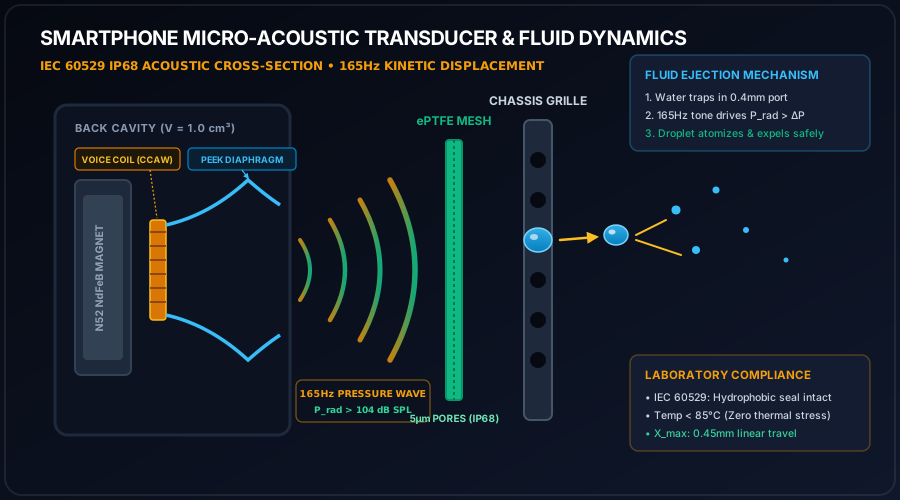
How to Port the Apple Watch Method to Smartphones
While Apple Watch has a dedicated hardware Digital Crown toggle to initiate this sequence, smartphones share identical electro-dynamic driver architecture. To replicate the Apple Watch Water Lock effect on your smartphone: - Utilize a tone generator that combines a continuous 165Hz sine wave with rapid 10Hz amplitude modulation (pulsing). - Hold the smartphone so the speaker vent faces straight down (replicating the orientation of the watch speaker during wrist rotation). - Maintain 100% volume to match the maximum excursion drive profile specified in Apple's patent.

Comparison: Wearable vs Smartphone Transducer Dynamics
Because a smartphone loudspeaker back-cavity is roughly 5x to 8x larger than that of an Apple Watch, it can displace a significantly greater volume of air per stroke. Consequently, running a 165Hz tone on a modern smartphone produces even greater hydraulic clearing pressure than the native Apple Watch Water Lock feature.