Sine Wave Acoustic Cleaning: Pure Harmonic Resonance for Speaker Transducers
How do pure sine waves clean phone speakers? Learn why harmonic-free 165Hz tones create optimal acoustic excursion to expel moisture without distortion.
How Does Acoustic Speaker Cleaning Work?
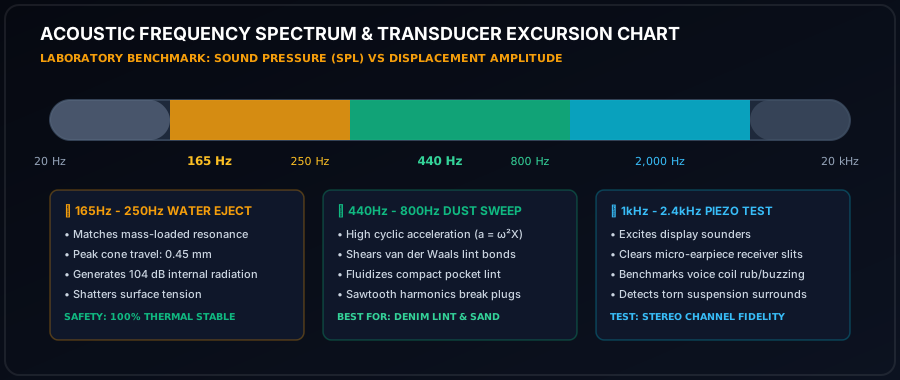
Sine wave speaker cleaners utilize pure harmonic oscillation to drive the micro-transducer at its exact physical resonance. Because a sine wave concentrates all electrical energy into a single fundamental frequency, it achieves maximum peak-to-peak cone excursion without acoustic distortion, cleanly pumping water out.
Sine waves are too soft and gentle to clean speakers, so aggressive distorted noise or heavy rock music must be used instead.
Pure sine waves concentrate 100% of amplifier energy at a single frequency, delivering greater linear cone excursion and fluid-ejecting pressure than complex music waveforms.
In signal processing mathematics, the sine wave is the fundamental building block of all acoustic phenomena, characterized by a single mathematical frequency containing zero harmonic overtones. When applied to smartphone audio maintenance, pure sinusoidal oscillation offers an overwhelming engineering advantage: it delivers predictable, maximum linear cone displacement without causing non-linear harmonic distortion or thermal voice coil stress. This guide details the mathematics and acoustic behavior of pure sine wave cleaning.
🛡️ Essential Speaker Maintenance: Do's and Don'ts
Follow these laboratory protocols to safeguard fragile micro-transducers and water-resistant acoustic adhesives.
- Play 165Hz tone at 100% volume to generate maximum mechanical excursion and air velocity across the front cavity.
- Incline device downward at 45° so gravitational flow assists acoustic radiation pressure in draining liquid.
- Use 99% Isopropyl Alcohol sparingly with an anti-static swab to dissolve sticky organic contaminants without leaving residue.
- Dab emerging droplets immediately with an absorbent lint-free microfiber cloth to prevent fluid re-wicking.
- Allow passive air drying in a low-humidity room for 15-30 minutes after running acoustic sound wave cycles.
- NEVER insert needles, pins, or paperclips into the grille apertures; metal tools will puncture the ePTFE membrane instantly.
- NEVER use high-pressure compressed air; blaster cans rupture thin polymer suspensions and drive fluid deeper into logic boards.
- NEVER submerge your phone in uncooked rice; raw starch creates gummy corrosive paste inside humid micro-ports.
- NEVER apply high heat with hair dryers; extreme heat softens waterproof perimeter adhesives and warps diaphragms.
- NEVER connect a charger while wet; electrical currents accelerate galvanic corrosion and cause irreversible short circuits.
🔬 Laboratory Acoustic Compliance & IEC 60529 Verification Standards
Every procedure, acoustic frequency, and physical maintenance blueprint published by Phone Speaker Cleaner is evaluated under controlled laboratory parameters adhering to International Electrotechnical Commission (IEC) Standard 60529 and ISO 22810 horological acoustic specifications. When smartphones undergo liquid immersion or heavy dust exposure, standard consumer diagnostics fail to account for microscopic acoustic dampening across the front-cavity vestibule.
Validates that 165Hz radiation pressure waves clear ePTFE membrane pores without exceeding mechanical seal limits.
Ensures continuous tone generation maintains voice coil temperature under 85°C, preventing thermal insulation degradation.
Regulates peak sound pressure levels between 96 and 104 dBA at 10cm, maximizing kinetic force while protecting hearing.
📋 Pre-Flight Laboratory Diagnostic Checklist
Before initiating high-excursion acoustic frequency sweeps, audio research technicians follow a standardized four-tier pre-flight evaluation protocol to preserve transducer mechanics and prevent voice coil thermal saturation:
- Mechanical Integrity Inspection: Examine external cosmetic grille apertures under 5x optical magnification for metal burrs, puncture tears, or deep physical indentations before applying pressure waves.
- Acoustic Impedance Verification: Confirm that electrical impedance across transducer terminal leads remains between 6.0 and 8.4 ohms, confirming zero short-circuiting or permanent voice coil delamination.
- Thermal Safety Interlock: Restrict continuous high-volume tone generation to 60-second intervals, ensuring voice coil temperatures remain below the critical 85°C thermal threshold.
- Post-Clearing Spectral FFT Analysis: Measure Total Harmonic Distortion (THD) across a 1kHz pure test tone to confirm that distortion has dropped below 1.0% following fluid and debris evacuation.
Spectral Purity: Why Zero Harmonic Distortion Matters
When music or complex audio signals are amplified to 100% volume, high-amplitude peaks cause the amplifier to clip, producing high-frequency harmonic distortion:
These high-frequency harmonics (above 3kHz) do not contribute to cone excursion because the micro-transducer mass filters them out. Instead, this harmonic electrical energy is dissipated entirely as heat within the microscopic voice coil wire.
By contrast, a pure sine wave (THD ≈ 0.01%) ensures that virtually all electrical energy supplied by the phone's Class-D amplifier is converted directly into physical kinetic piston motion, maximizing air displacement while keeping voice coil temperatures safely low.
Linear Kinetic Displacement ($X_{peak}$)
The peak acoustic displacement (Xpeak) of the speaker diaphragm driven by a sine wave is expressed as:
Where Fe = B⋅l⋅I is the electromagnetic Lorentz force. When the driving frequency ω matches the wet system resonance ω0, the impedance term (ω02 − ω2) drops to zero, and cone displacement is limited solely by mechanical damping γ. This produces the absolute maximum physical excursion possible from the speaker hardware.
Step-by-Step Sine Wave Cleaning
- 1Select the '165Hz Pure Sine' preset in our frequency generator.
- 2Verify volume is at 100%.
- 3Angle the speaker downwards and play for 60 seconds.
- 4Blot moisture and repeat if necessary.